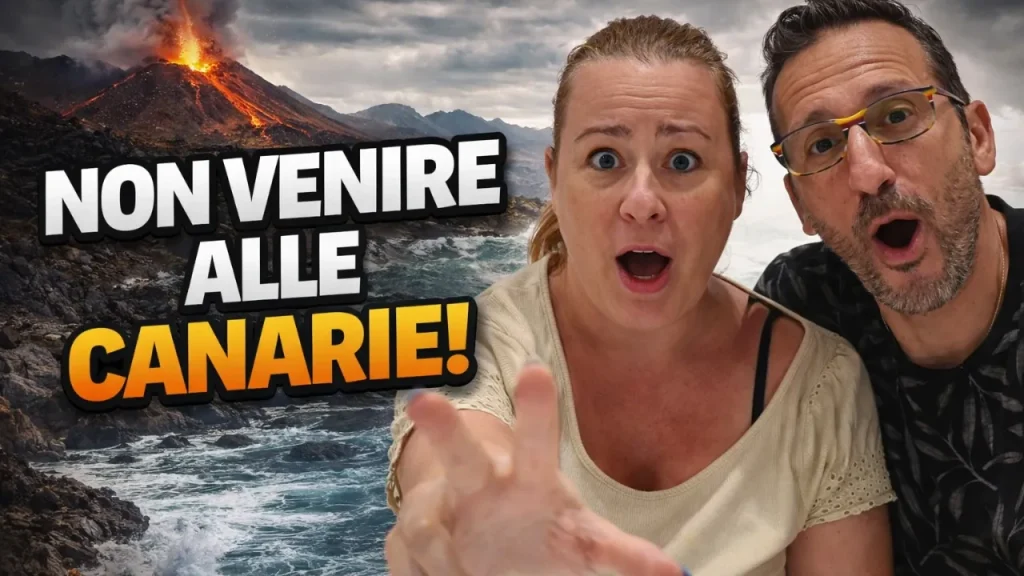
Dreaming of leaving everything behind and living "on sun and sea"? Before selling your house, stop. In 2026, the narrative of the Canary Islands as a low-cost paradise has become a trap for many. Luca and Selvaggia, residents of the archipelago since 2014, analyze the real reasons why you should stay in Italy. From the saturated real estate market to the language barrier, here's why the Canary Islands aren't the solution to your problems, but could become a new headache.
1. The Myth of Salary and the Cost of Living
The first reason for not moving is economic. Many arrive with the idea of living in the Canary Islands with “a thousand euros a month”, but in 2026 the reality is different:
- Local Salaries: For a standard job (commerce, services), the salary varies between 1,200 and 1,400 euros.
- Rents on the Rise: Strong demand from digital nomads and investors has caused house prices to skyrocket. Renting a decent apartment in areas like Tenerife South or Las Palmas now costs as much as in a major Italian city.
- The 50% Rule: If you don't have an income or a remote job that exceeds €2,500, you risk spending your time working hard without enjoying paradise, just like you would in Italy.
2. Culture Shock and the “Mañana” Rhythm”
If you come from a busy city like Milan or Rome, you might hate the Canary Islands. The concept of “Morning by morning” It's not a figure of speech, but a pillar of local culture.
- Slow Bureaucracy: Getting documents or home repairs requires infinite patience.
- Informal Relations: Time is slow, and Milanese precision is seen as unnecessary stress. If you're not ready to embrace this slow pace, frustration will bring you back to Italy within two years.
3. The “Italian Bubble” Trap”
Many Italians fail to relocate because they don't integrate. Remaining confined to Los Cristianos Speaking only Italian drastically limits your work and social opportunities.
- Language is the Key: Without fluent Spanish (not "Italian-Spanish"), you'll always be a guest. In 2026, institutions and the job market require real language skills to access senior positions.
- Nostalgia and Loneliness: Without integration, the lack of the original network of affections (relatives and historical friends) becomes unbearable after the initial euphoria phase.
4. Beyond the Postcard: Calima and Microclimates
It's not always sunny and 77 degrees. Luca and Selvaggia explain the natural challenges no one tells you about:
- Extreme microclimates: You can go from the scorching heat of the coast to the fog and 15 degrees of the forest of Anaga in just 40 minutes.
- The Calima: The Saharan wind brings sand and dust, raising temperatures and reducing visibility. In 2026, these phenomena are more frequent and can cause discomfort for those with respiratory problems.
- The Ocean is not the Mediterranean: Atlantic currents are strong, and the water is generally colder. Swimming isn't always possible without worries.
Frequently Asked Questions
Who should never move to the Canary Islands?
Those seeking a getaway to solve personal problems, or those requiring an ultra-efficient bureaucratic and work system. Those without a savings account for the first 12 months, or those refusing to learn the local language.
Are the Canary Islands safe in 2026?
Yes, they remain one of the safest places in Europe, but like any heavily touristed area, you need to be careful in the most crowded areas. Real safety is felt in the small villages of the north, where life still flows at an old-fashioned pace.
How to avoid transfer failure?
By coming for a month to scout out the tourist areas, studying Spanish before leaving, and having a solid professional plan (remote work or innovative business) that doesn't depend exclusively on local mass tourism.
Why do Luca and Selvaggia recommend the north of the island?
The North offers a more authentic, green, and less "concrete" experience. Although the climate is more humid and variable, integration with the local culture is deeper, and rental costs are slightly lower than in the touristy south.