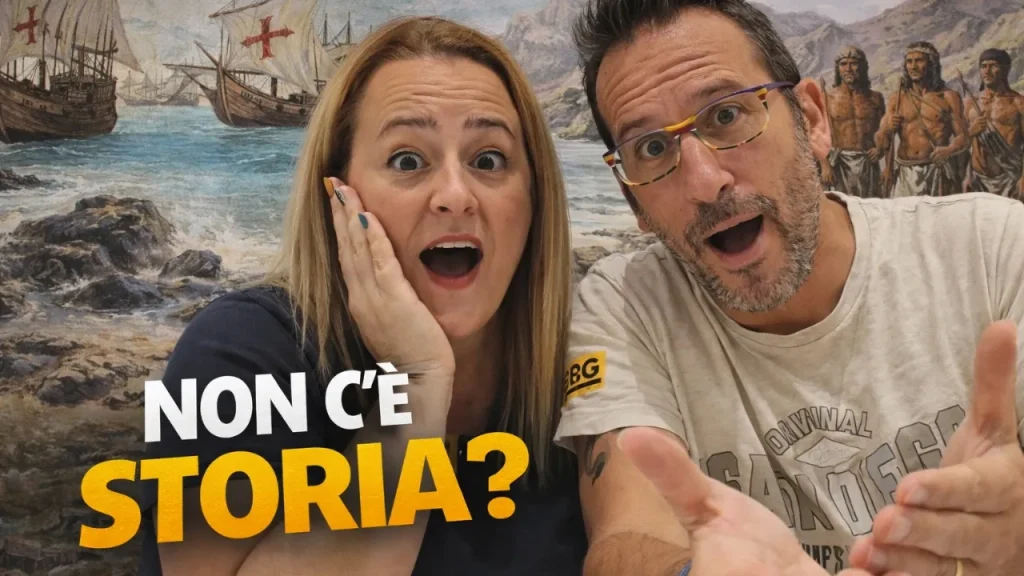
“There is no history in the Canary Islands.” This is one of the phrases that Luca and Selvaggia, residents of the archipelago since 2014, hear this more often. But the reality is exactly the opposite. In this new study, we debunk the myth of the islands as a simple "GardaLand of the Atlantic" to discover a cultural richness rooted in the 15th century, and which sees Italians as forgotten protagonists.
The Prejudice of “No History”
Why do many Italians believe the Canary Islands lack culture? According to Luca and Selvaggia, the problem is the kind of "hit-and-run" tourism that's limited to the southern beaches and nightclubs. Those who stop at the surface see only resorts and concrete, but a few kilometers away you'll find centuries of history.
Living in the Canary Islands in 2026 also means honoring the legacy of the Guanches (the aborigines of the islands) and understand how the Spanish invasion transformed this outpost into the gravitational center of world trade between Europe, Africa and the Americas.
Italians in the Canary Islands: A Centuries-Old Bond
Perhaps not everyone knows that between the 15th and 16th centuries, merchants Genoese and Ligurians were among the main economic drivers of the islands. The Canaries were not only a transit point for Christopher Columbus, but a true strategic hub where Italian entrepreneurship has left indelible marks on the architecture and local economy (think of the production of sugar and wine).
Garachico: The “Gateway to the World” Destroyed by the Volcano
A clear example of the historical density of the Canary Islands is Garachico, in Tenerife. Before the volcanic eruption of 1706, Garachico was the island's most important trading port. Luca and Selvaggia describe how this village was the connecting point between the old and new worlds.
- The Eruption: Lava destroyed the once prosperous port, forcing trade to shift to Santa Cruz.
- Today: Garachico remains an architectural jewel that bears witness to the resilience of the Canarian people and the wealth of a golden age of trade.
Beyond Mass Tourism: Museums and Historic Villages
For those who really want to "get to know" the Canary Islands, Luca and Selvaggia recommend leaving the tourist areas and visiting:
- San Cristobal de La Laguna: A UNESCO World Heritage Site, with colonial architecture that served as a model for Latin American cities.
- Icod de los Vinos: Famous for its Millenary Dragon and its centuries-old winemaking tradition.
- The Museum Network: From the Casa de Colón in Las Palmas to the MUNA in Santa Cruz, where you can discover the pre-Hispanic and natural history of the archipelago.
Frequently Asked Questions about Canarian Culture
What are the most historic cities in the Canary Islands?
The cities with the greatest historical density are San Cristóbal de La Laguna and Garachico in Tenerife, Vegueta (the historic district of Las Palmas) in Gran Canaria, and Betancuria in Fuerteventura.
Are there any archaeological sites that can be visited?
Certainly. Sites like the Cueva Pintada in Gran Canaria or the Guanche interpretation centers in Tenerife offer a profound insight into the lives of indigenous peoples before the Spanish conquest.
What is the connection between Italy and the history of the Canary Islands?
The bond is very strong: Genoese navigators (such as Lanzarotto Malocello, from whom Lanzarote takes its name) and Ligurian merchants were among the first Europeans to settle and invest permanently in the islands between 1400 and 1500.
Why are the Canary Islands considered a “bridge” between continents?
Due to their geographical location and the trade winds, the islands were for centuries the last obligatory stop for ships bound for the Americas, influencing the cuisine, music and architecture on both sides of the Atlantic.